
Compare Hall County Recorded Values
In Hall County, the assessor appraises each parcel at full fair-market value, and taxable value is set at 40 percent of that appraisal. The assessor builds the value. The Tax Commissioner then applies exemptions, millage, credits, and the other lines that shape the final bill. A deed or transfer record tells a different story. It documents a sale event, nothing more. Keeping these sources in their lanes keeps a tax figure from being mistaken for a likely sale price.
| Value | What It Is | Where |
|---|---|---|
| Fair-market value | County mass-appraisal estimate at full value | Hall Tax Assessor |
| Assessed value | Forty percent of fair-market value before applicable tax treatment | Assessment record and tax statement |
| Last sale price | Consideration tied to a past transfer, not a current estimate | Recorded deed and sales display |
| Land and building values | Components of the county value | Parcel card and tax statement |
Run the math on a simple example. A $100,000 fair-market estimate becomes a $40,000 assessed amount before exemptions under the stated ratio. That number explains the arithmetic only. It is no claim about any real Hall County parcel, tax rate, or bill. For bill and payment context, the Hall Tax Commissioner property page is the right stop. It does not hold the county's appraisal decisions, though.
Read Hall County Value Fields
The official tax-statement explanation treats the map code as the unique parcel key. Around it sit separate fields for building and land fair-market values, total fair-market value, exemptions, the assessed or taxable basis, tax district, due date, and calculation lines. Always save the tax year alongside those figures. Without it, the numbers lose their frame. Hall tax-sale examples show map codes with spaces and optional letters. Copy the full string exactly. Shortening or decoding it breaks reproducible comparisons later. Land and building components can shift for different reasons. A new structure, a demolition, a lot split, or a corrected characteristic may change one field without any market sale behind it. Check permits, plats, and the valuation year before explaining the change.
Apply Hall County's Forty Percent
The Hall County Tax Assessor sets fair-market value using current sales and Georgia Department of Revenue rules. Georgia's assessment ratio then drops taxable property to 40 percent of that amount. That step comes before exemptions and the other bill factors. The ratio is not a discount. It does not tell you what a buyer would pay. It is simply one stage in the public tax calculation, so a useful comparison log keeps fair-market, assessed, exempted, and taxable amounts in separate columns.
The official Hall County Tax Assessor page links the parcel and assessment services behind any value lookup.
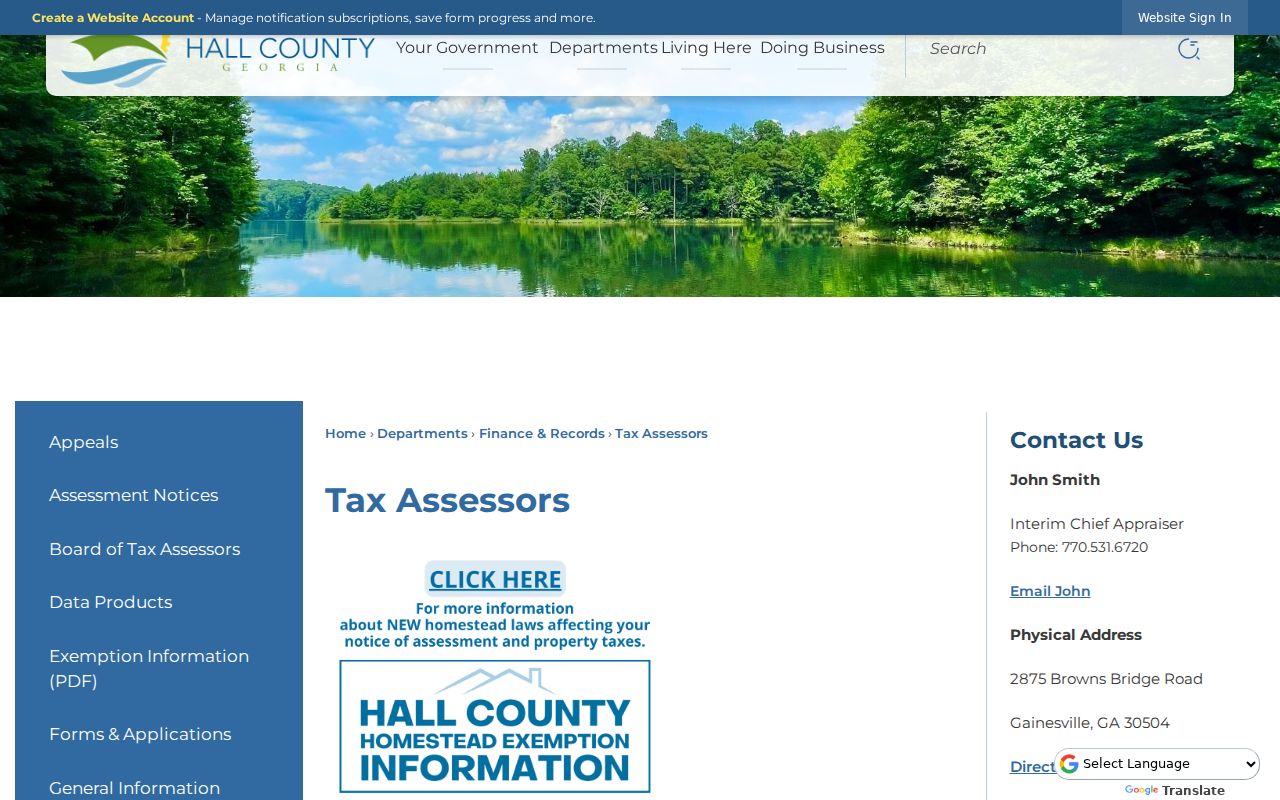
That county page is the reliable launch point whenever a saved qPublic address or interface changes.
Look Up Hall County Assessed Value
The county links qPublic from its assessor and service-maps pages. The live field order varies. Match the labels in the current interface rather than assuming a fixed form.
- Search the situs address through the Hall qPublic link. If it fails, use the map or an exact map code.
- Confirm the parcel, then record land, building, total fair-market, and assessed values with the year.
- Note exemptions and tax district, but keep those tax-account facts separate from the value estimate.
- Check the latest recorded deed for transfer date and consideration context. Do not label that old sale as today's value.
- Assessed value
- The statutory percentage applied to fair-market value for tax purposes.
- Fair-market value
- The county's full-value mass-appraisal estimate.
- Assessment ratio
- The percentage used to convert fair-market value to assessed value.
- Sale consideration
- The amount tied to a recorded transfer, subject to the instrument's terms.
- Reassessment
- A later review or update of the county's value estimate.
Separate Hall County Sale Price
A sale-history line is a clue, not a complete deed. Some displayed events may record an assessment transaction rather than a full title transfer. Before trusting a price, confirm the grantor, grantee, instrument type, date, book and page, and legal description. Use the Hall Clerk and GSCCCA. Timing matters too. Compare transactions from a relevant period. Match similar parcel context. A distant sale can distort a quick price comparison. A family transfer, a partial-interest deed, or a changed tract can do the same. When working with the county's valuation date, use prior-calendar sales. Preserve each comparable's parcel code. Similar street names alone prove nothing about similar land, improvements, access, or legal rights. Read the instrument itself. A deed may convey less than the whole parcel. It may reserve rights. It may also reflect a family relationship that makes its consideration a weak market signal. Compare the legal description carefully. A clean price column should state why each sale was kept or excluded.
Time Hall County Value Updates
Hall says its qPublic parcel, assessment, and sales map data is updated weekly. Weekly publishing does not mean a newly recorded deed has already reached the assessment roll. The county also reported that ownership changes once lagged up to four months. A new 2024 processing system aimed at about one week. That improvement was a county report, not a guaranteed service level. Date-stamp the parcel card. Check the newest deed when a recent sale affects your value analysis. Annual responsibility has its own date frame. The Tax Commissioner states that the owner of record on January 1 owes that year's bill. A later buyer may see a different present owner, sale date, and billing name. Each record was correct for its own purpose.
Distinguish Hall County Taxable Value
Exemptions can lower the taxable basis without touching the fair-market estimate in the same way. Hall's filing window for exemptions, returns, and proposed-value declarations recurs each year. It runs from January 1 through April 1. Homestead applications may be filed year-round. But the current appeal-window deadline decides whether one affects that tax year. The valuation question stops at identifying these fields. Bill calculation and payment status belong with the Hall County property tax records. Deadlines and appeal steps belong there too.
Use Hall County City Context
City zoning stories rarely price a parcel. Gainesville changed its development code, Flowery Branch drafted Old Town and Commercial Gateway plans, and Oakwood's I-985 and sewer history shaped whole corridors. That context can explain different land-use settings. It cannot deliver an official citywide price trend. Collect the parcel's county value, sale date, map code, and tax district before reading any city policy into the number.
A mailing city can mislead, too. It may not prove municipal jurisdiction, so confirm city limits and the responsible permit or zoning office before attaching city policy to a valuation record. Planning history stays useful for land-use questions. Label the comparison as a parcel example, align the tax years, and avoid projecting a county estimate from corridor history alone.
Limit Hall County Property Value Claims
An assessor value is mass appraisal. No appraisal inspects every feature. The figure exists for public tax administration, so read it as context, remembering that GIS lines are not boundaries and a past sale does not guarantee present condition or demand.
Value versus price. A Hall County assessed value serves taxation. It is not a promised sale price and is not a licensed appraisal.
Public values earn their keep as context and verification. For a transaction or dispute that turns on current market worth, get qualified parcel-specific advice. Keep that opinion's effective date, inspection scope, and purpose beside the public record figures.
A Hall County figure that looks wrong deserves a first check, not an argument. Confirm the parcel and year. A wrong map code, stale sale, split tract, or unmatched city edge can create a false comparison before any valuation method even enters the room.
The assessor also sells public copies for a nominal fee. When the portal omits a field needed for a dated comparison, request the existing parcel or assessment record and name the tax year, map code, and format you prefer.
Write the source beside every number. A parcel card, deed, and tax statement can each be accurate while reporting different amounts for different dates and purposes. That distinction matters most. It anchors any sound Hall County value comparison.