
Trace Hall County Former Owners
Tracing past owners of land in Hall County takes patience. But the records make it possible. Hall County property records reveal ownership one transfer at a time, since no office keeps a tidy list of every former owner. You start with the current parcel. Pull its most recent deed, and then work backward seller by seller. Each deed names the person who sold, which points you to the deed before that. A search of Hall County property records by address or parcel number gets the first link, and older transfers may send you to deed books, plats, and archives held by the Clerk.
| Record source | Time reach | Access point | Use in the chain |
|---|---|---|---|
| GSCCCA real-estate index | Online dates vary by search | GSCCCA | Party, instrument, date, book and page |
| Recorded deed books | County records date to 1818 | Hall Clerk Real Estate Division | Earlier vesting deeds and legal descriptions |
| Recorded plats | Varies by tract | GSCCCA and Hall Clerk | Lot, block, roads, easements and adjoining land |
| Directories and historic maps | Collection-specific | Digital Library of Georgia | Address and neighborhood context, not title |
For a recent transfer, begin with the assessor lead and GSCCCA. When the chain reaches past the online index, contact or visit the Hall County Clerk of Superior Court Real Estate Division. Directories, Sanborn maps, photographs, and newspapers can help with a changed address. None of them can replace a deed.
Build a Hall County Deed Timeline
A deed-chain table keeps names and dates from drifting apart. Treat the sample labels as placeholders only. Fill in a row only after reading the indexed instrument or a Clerk copy and confirming that its land description matches.
| Transfer date | Grantor to grantee | Deed type | Book/page |
|---|---|---|---|
| Latest recorded transfer | Current seller to current grantee | As indexed | Exact citation |
| Prior transfer | Earlier owner to later owner | As indexed | Exact citation |
| Earlier book entry | Prior grantor to prior grantee | As recorded | Clerk book/page |
Execution and recording dates can differ. Record both when the deed shows them. Copy the acreage, land lot, district, subdivision, lot, block, and any referenced plat data too, so two people sharing a name never merge into one false chain.
Hall County Online Dates Conflict
The GSCCCA coverage description states that every county has deed-index data. That data goes back to at least January 1, 1999. The central search page lists a range. It runs from January 1, 1990 through August 4, 2026. Neither figure tells you Hall County's true first day online. Check the good-from result for Hall at the time you search.
Online cutoff. Do not promise 1990 or 1999 as Hall County's start date; older former owners may be found only in Clerk-held books and indexes.
This gap matters. A blank web result may simply mean the deed predates the online range. It does not mean the transfer never happened.
Reconstruct Hall County Ownership Backward
The backward method treats people only as links in the land's chain. Use the GSCCCA name search with Hall County selected. Add party type, instrument type, and a sensible date range. Once you hold a citation, a book and page search is far more exact. It beats another broad name query. The official GSCCCA book and page form provides that direct citation route. An earlier deed supplies the two keys.
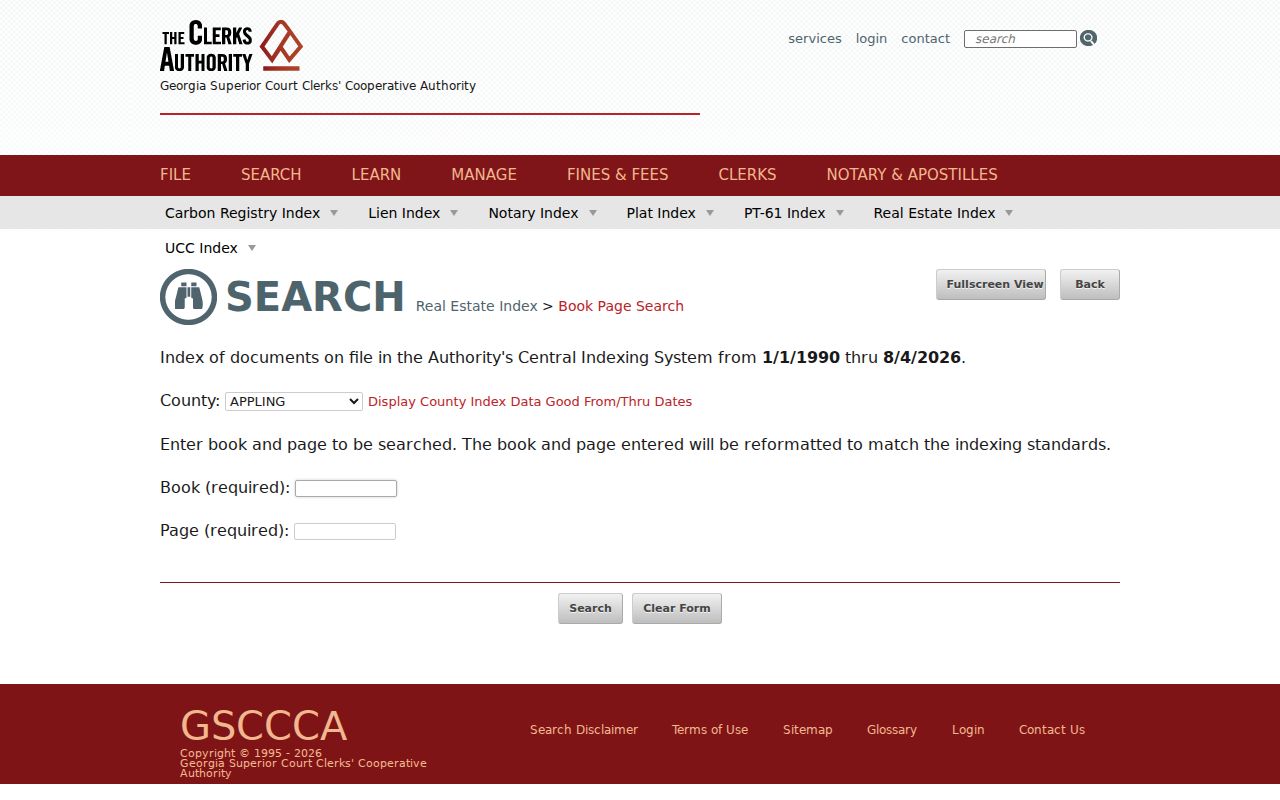
This form narrows the hunt to one cited instrument, which locks a single transfer into the backward chain.
- Find the latest vesting deed with the current party shown as grantee. Match the legal description and map code context.
- Read the grantor from that deed. That grantor is the next prior owner lead.
- Search the grantor as a grantee in an earlier date range. Confirm the next deed by book/page and land description.
- Repeat until the online index ends, then ask the Clerk for the deed book and index covering the next earlier year.
- Grantor
- The party conveying an interest in the deed.
- Grantee
- The party receiving that interest.
- Chain of title
- The ordered series of instruments tied to the same land.
- Legal description
- The recorded words identifying the tract, lot, land lot, boundaries, or referenced plat.
- Reverse index
- An index route used to find the deed by which a seller earlier acquired the land.
Search Hall County Party Variants
Former owners appear under many labels. They may be individuals, spouses, trusts, estates, limited-liability companies, or fiduciaries. Search surname-first for people and test the full legal entity name for companies. An executor's deed, administrator's deed, deed of assent, trust conveyance, or quitclaim can form a valid link. A warranty-deed-only search will miss that link. Match every candidate against the land itself. A familiar name or mailing address proves nothing. Search both sides of the transfer. Keep the instrument type, execution date, record date, and exact book and page.
Follow Hall County Plats and Splits
A parcel can change shape or map code. The land stays inside the same historical chain. Hall's plat process assigns a plat book and page after electronic recording. Then GIS may issue new addresses and the assessor may create new parcel numbers. So an approved plat can exist before any new parcel shows on the tax roll. Bridge the change with lot, block, acreage, land lot, district, roads, easements, and adjoining-owner notes. Not every Hall County property has a plat. A plat filed under an old owner or subdivision name does not convey title either. Only the deed link answers who owned the tract.
Reach Hall County Records Offline
The Real Estate Division sits at the Courthouse Annex, 116 Spring Street SE in Gainesville. It answers at 770-531-7025. The Clerk FAQ notes that an in-person lookup can begin with just a year and a name. In-person copies run $0.50 per page. Mail requests for a known book and page cost $1 per page. GSCCCA adds free public indexing plus account-based image access. For older former owners, bring the Clerk an approximate year, the names, your book and page trail, and the legal description. The Digital Library of Georgia Hall collection can add city directories, photographs, tornado material, and other address clues when the street context changed.
Hall County Historic Indexing Continues
Hall County approved a $96,027.40 Kofile award in July 2025. The award funds Clerk record preservation, digital archiving, and historic indexing. That is real progress. Still, an award is not a finished project. Do not assume every historic book is now online. Log the portal access date each time you search. Hall's custody claim dates to the county's 1818 founding. That history runs far deeper than the modern online index. When a chain of records stops, turn to a bound book. An older index may fill the gap too. Guessing at a missing owner is not research.
Historical setting matters too. Gainesville's railroad arrival, the 1851 fire, the 1936 tornado, and Lake Lanier construction all reshape the picture. They can place a tract in a world that no longer matches its street label today. Newspapers, city directories, Sanborn maps, old plats, and land-lot descriptions all help. Gather that context first. Then return to the deed before adding anyone to the ownership chain.
Measure Hall County Ownership Depth
Hall County names the Clerk as custodian of its records. Those records date to the county's founding in 1818. That does not mean one parcel's chain runs cleanly to that year. Boundary changes, tract splits, and estate transfers can all break the line. So can name variants, missing images, and changed street context. The goal is simple. Reach the oldest verified instrument tied to the same land, and label any gap honestly.
Lawful use. Research Hall County former owners for house history and property diligence. Never use owner data to track, intimidate, or harm a living person.
A records chain is not a title opinion. For a purchase, boundary dispute, or estate matter, get a qualified Georgia professional. Have that professional review the deeds and exceptions. Keep copies or citations for every link. Note each unresolved gap, and date the final research log.
When liens matter to the history, recheck releases, security deeds, and liens. Also recheck FiFa entries tied to each ownership period. A proper later release cites the earlier instrument. A transfer alone never proves all prior charges were cleared. Compare instrument dates against your timeline and flag any overlap for a closer look.