
Read a Hall County Property Tax Record
A Hall County tax statement pairs the local Map Code with value and billing details. Georgia works from a simple chain. The assessor appraises each parcel at full fair-market value. The state then applies a 40 percent assessed ratio after exemptions. Millage plus credits and fees produce the final bill. The Tax Commissioner handles receipts, payment status, and delinquency facts.
| Field | What It Shows | Where |
|---|---|---|
| Fair-market value | Assessor's estimate at full value | Tax Assessor |
| Assessed value | Forty percent tax basis before exemptions | Tax Assessor |
| Land and building | Separate value components | Assessment and statement |
| Exemptions | Relief applied to eligible value | Assessor and bill |
| Bill and status | Due date, amount, paid or delinquent state | Tax Commissioner |
| Tax district | Jurisdictions used in the levy | Tax statement |
One caution: a last sale price is a recorded event. It is not the assessor's current value conclusion. Exemptions can shift taxable value without touching the property itself, so always compare figures from the same tax year before drawing any conclusion.
Separate Hall's Assessor From Its Tax Commissioner
The Hall County Tax Assessor handles valuation, returns, exemptions, and appeals, with an office at 2875 Browns Bridge Road in Gainesville, reachable at 770-531-6720 on weekdays from 8 a.m. to 5 p.m. The Tax Commissioner takes over from there. That office bills, collects, distributes, and reports payment or delinquency status. The Tax Commissioner's official property page displays the billing and payment details described here.
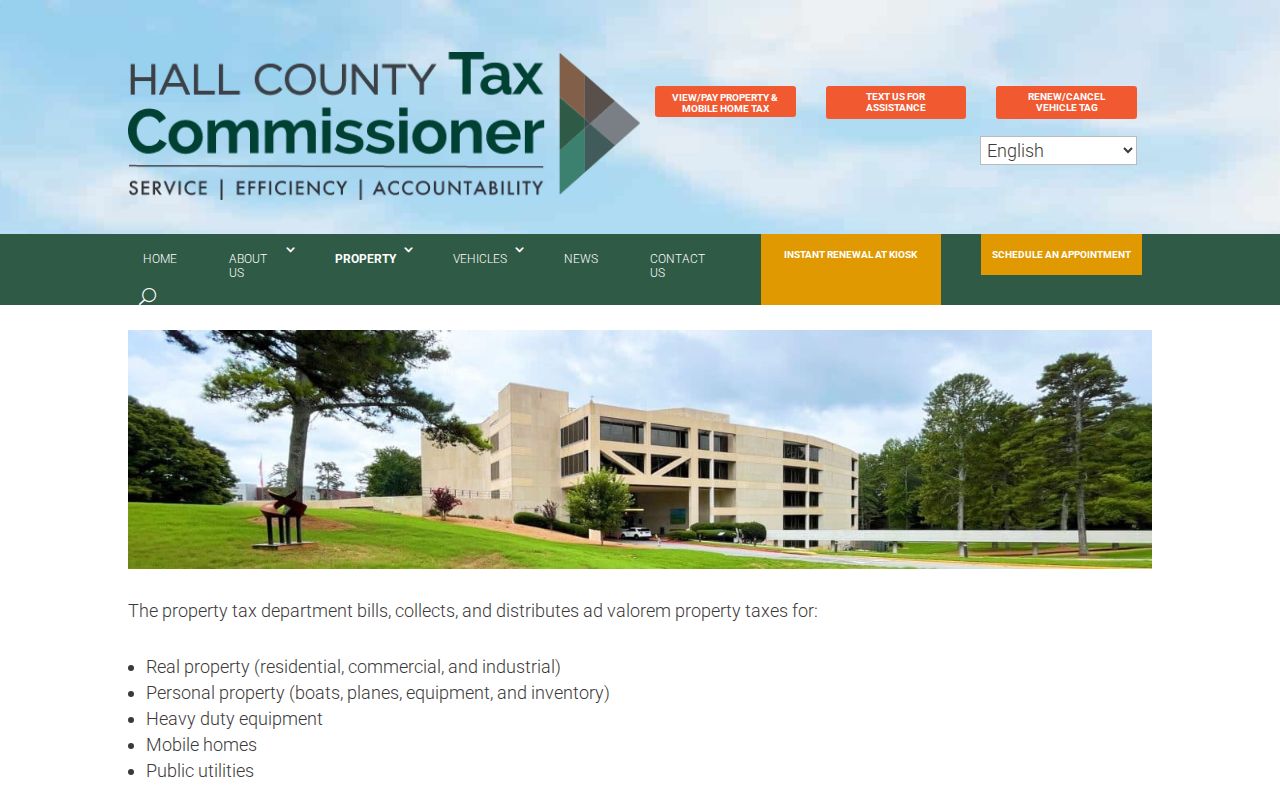
Bring bills, receipts, FiFas, and tax-sale questions to this office, since it cannot revisit fair-market value.
Calculate the Hall County Forty-Percent Assessment
Hall County's formula runs in a fixed order. Fair-market value comes first, then the 40 percent assessment ratio, then any exemptions, then millage with credits or fees. Keep the steps straight. A bill can move because of value, exemptions, millage, the district, or an added charge, so the total alone never tells you which part shifted.
- Fair-market value
- The assessor's full-value estimate.
- Assessed value
- Forty percent of fair-market value before applicable exemptions.
- Millage
- The levy applied to taxable assessed value.
- FiFa
- A tax execution recorded for delinquent debt.
Check Hall County's January 1 Owner Rule
Whoever owns the parcel on January 1 owes that year's tax. That is the rule. A sale later in the year can leave the annual statement in the previous owner's name even after a new deed records. Mortgage companies do not automatically receive the homeowner's statement either, so a payment arrangement should never replace a direct status check. On timing, the county gives two versions. The current Tax Commissioner property page says statements mail September 15 and come due November 15, while the FAQ describes a fall mailing with payment due 60 days later. Trust the due date printed on the actual bill.
Look Up a Hall County Tax Bill
Begin with the property address or Map Code and pin down the tax year. Read the fair-market, assessed, and exemption lines before you look at the amount due. Then check the district, due date, payment state, and any delinquent year or FiFa. HallCountyTax shows payment status. A 2025 county notice says receipts are available for ten years back.
- Search the Tax Commissioner route by address or Map Code.
- Select the tax year and compare the owner date and district.
- Read values, exemptions, due date, and paid or unpaid status.
- Check prior receipts, delinquency, FiFa, and any current sale notice.
- Assessed value
- The value produced by the statutory assessment ratio.
- Mill rate
- The levy used to calculate tax.
- Homestead exemption
- Eligible relief tied to the taxpayer's qualifying home.
- Tax lien
- A claim securing unpaid property tax.
File Hall County Exemptions on the Right Calendar
January 1 through April 1 is Hall County's recurring window. That window covers exemptions, property returns, and proposed-value declarations. Homestead applications may be filed any time during the year. To affect a given tax year, though, the application must arrive in time. It must land before that appeal window closes. Specialized programs can require separate eligibility documents. So rely on the assessor's own form and instructions rather than assuming the bill updates on its own. Remember what an exemption does and does not do. It changes the taxable calculation. But it does not rewrite a deed, establish occupancy for another purpose, or move a parcel boundary. After filing, confirm the exemption shows up in the correct year.
Read Hall County Delinquency and Tax-Sale Records
A bill goes unpaid after notice. The Tax Commissioner then records a FiFa in the Clerk's General Execution Docket. The county's tax FAQ says a FiFa lasts seven years. It can be renewed indefinitely. Current sale lists show tax years due, parcel number, owner name, address, city, and amount. But they shift often. Payment, bankruptcy, cancellation, or a court order can remove a property at any point. Hall sells a Sheriff's Tax Deed. It is not a warranty deed. The county describes a 12-month redemption period. It urges bidders to investigate title, other taxes, liens, code compliance, utilities, septic, and easements first. Treat any sale listing as a due-diligence lead, never as proof of clean title.
Understand Hall County Late Charges and Receipts
The Tax Commissioner FAQ spells out the late charges. Interest runs at prime plus three percent, expressed there as 0.8125 percent monthly. Penalty notes run 5 percent after 120 days with a 20 percent cap. Rates, dates, and account facts change. Apply any figure only to the official year and account in front of you. Never project an old statement forward. Keep the receipt, bill year, access date, and Map Code filed together. Ten years of online receipts help reconstruct payment history. Older status may take a direct office request. Note that paying a bill never settles a separate ownership or boundary dispute.
Match your request to the right office. The Tax Commissioner handles bills, and a Map Code plus tax year beats a street address for locating an account. Assessment-side papers, such as exemption decisions or returns, belong with the assessor instead. Ask for one thing at a time. A specific request for a receipt, statement, or appeal record keeps two offices from answering different questions under the broad label of a tax record.
A FiFa needs its own paper trail. Copy the execution reference and search the Clerk's General Execution Docket for the lien and any later release. A paid bill and a released FiFa are separate records. Tax-sale listings shift. Payment, bankruptcy, cancellation, or another legal event can remove a parcel, so recheck the listing near the sale date. Keep the publication date with every entry you download.
Appeal a Hall County Assessment
Hall County's online appeal instructions allow challenges on five grounds: value, uniformity, taxability, denial of an exemption, or breach of a covenant. Meet the deadline. The date appears on the annual assessment notice. Pick a permitted route and upload your evidence. Strong support includes comparable sales from the prior calendar year, photographs, a private appraisal, repair records, corrected characteristics, and consistent parcel comparisons.
Remember what an appeal can change. It disputes the assessment, not the tax rate or a recorded deed. Save the confirmation and every attachment. Then track the Board of Equalization or whichever route you selected, and see the Hall County property value guide for the value-versus-sale distinction.
Use the notice deadline. Hall assessment appeals must be filed by the date on the annual notice; the general exemption season is not a substitute.
Save assessment notices and tax bills as separate records. Hall County reported issuing 82,471 property notices and 12,726 personal-property notices in its 2024 accomplishments. Those figures show the scale of the assessment process. They do not count taxable parcels or appeals. Keep the annual notice, appeal confirmation, Board decision, final bill, and receipt together so each step keeps its date and purpose.
Address changes follow the assessor's formal route too. A new tax mailing address does not amend the deed, prove occupancy, or pull a parcel into a city. Compare the situs address, owner mailing address, city-limits layer, Map Code, and tax district before drawing conclusions. Municipal edges get confusing. A Gainesville, Flowery Branch, or Oakwood mailing label may not match the corporate limits, which can affect the permit office and district lines without changing Hall County custody of the assessment.
Open-records requests fill the gap. Use them for tax or assessment material that is not posted. Name the Map Code, address, tax year, and the specific notice or record you want. State a preferred electronic format. The first 15 minutes of staff time are free. After that, the lowest-paid qualified employee's rate may apply, plus page or media costs. Requests to Courts, Elections, Environmental Health, and Sheriff skip the ordinary NextRequest department route.
Tie market evidence to the appeal year. Hall's online instructions support value, uniformity, taxability, exemption-denial, and covenant grounds. Check each comparable by sale date, parcel, characteristics, and whether the transaction fits the prior-calendar period. A recorded consideration amount can inform review. But it is one sale event. It does not replace the assessor's mass-appraisal analysis or set the tax bill on its own.